

Radiation Oncology in Hyderabad: Understanding Radiation Therapy for Cancer
Radiation therapy is one of the three major pillars of modern cancer treatment, alongside surgery and systemic treatments such as chemotherapy, immunotherapy and targeted therapy.
For many patients, radiation therapy may be used as the main treatment. For others, it may be recommended before or after surgery, together with chemotherapy or other medicines, or to control symptoms caused by cancer.
Choosing the right Radiation Oncology team is therefore an important part of cancer care.
At Basavatarakam Indo-American Cancer Hospital & Research Institute in Banjara Hills, Hyderabad, Radiation Oncology is one of the hospital’s core oncology specialties. The department was established in 2000 with scientific support from Weill Cornell and Presbyterian Hospital, New York, and the hospital currently describes its Radiation Oncology service as part of a comprehensive cancer-care system supported by advanced radiation-treatment technology and specialist teams.
Radiation Oncology at Basavatarakam is integrated with other cancer specialties so that treatment decisions can be made according to the patient’s cancer type, stage, location, pathology, overall health and treatment goals.
For patients searching for Radiation Oncology in Hyderabad, Radiation Therapy in Hyderabad, or a Radiation Oncologist in Hyderabad, understanding what Radiation Oncology involves can help them have a more informed discussion with their cancer-care team.
What Is Radiation Oncology?
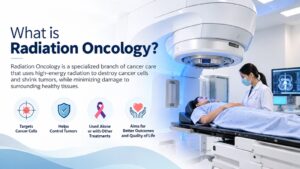
Radiation Oncology is the branch of medicine that uses radiation to treat cancer and, in selected situations, relieve symptoms caused by cancer.
Radiation therapy works primarily by damaging the DNA of cancer cells. When the damage is beyond repair, cancer cells stop dividing or die. The effects are not necessarily immediate; cancer cells can continue to die for weeks or months after treatment has finished.
Radiation can be delivered in different ways depending on the cancer.
The two broad approaches are:
- External beam radiation therapy
- Internal radiation therapy, including brachytherapy
In external beam radiation therapy, a machine outside the body directs radiation toward the area containing the cancer.
In brachytherapy, a radiation source is placed inside the body, in or near the tumour, allowing radiation to be delivered directly to the treatment area.
The choice of treatment is not based simply on the name of the cancer. Radiation Oncologists consider factors such as tumour size, location, stage, nearby sensitive organs, previous treatments and whether surgery or systemic treatment is also planned.
Why Is Radiation Therapy Used in Cancer Treatment?
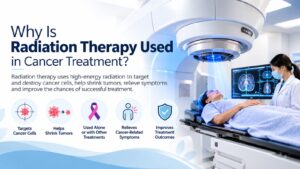
Radiation therapy can have different roles depending on the patient’s cancer and treatment plan.
Radiation as the main treatment
For selected cancers, radiation therapy may be used as the primary treatment.
This may be particularly relevant when the tumour can be effectively treated with radiation and surgery is not necessary, not preferred, or not appropriate.
Radiation may be recommended after surgery when there is a risk that microscopic cancer cells remain in the treatment area.
The objective is to reduce the risk of cancer returning in that region.
Radiation before surgery
In selected cancers, radiation may be given before surgery to reduce tumour size or improve local control.
Radiation with chemotherapy or other treatments
Some cancers are treated with a combination of radiation and systemic treatment.
Chemotherapy or another systemic treatment may be used alongside radiation when the combination is appropriate for the specific cancer.
Radiation for symptom relief
Radiation therapy can also be used for palliative treatment.
For example, radiation may help reduce pain or other symptoms caused by a tumour or cancer that has spread to certain areas of the body.
Therefore, radiation therapy is not simply a treatment used when surgery cannot be performed.
It can be an important component of curative, adjuvant, neoadjuvant, combined-modality and palliative cancer care.
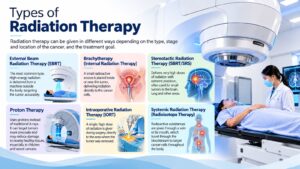
Modern Radiation Oncology offers several techniques. The appropriate technique depends on the individual cancer rather than simply choosing the most technologically advanced option.
- External Beam Radiation Therapy
External beam radiation therapy uses a radiation machine outside the body to deliver radiation to the tumour or treatment area.
The radiation does not need to touch the patient physically.
Treatment planning uses medical imaging and computer-based calculations to determine the appropriate treatment area and radiation dose.
Depending on the cancer, external beam treatment may include techniques such as:
- 3D conformal radiation therapy
- Intensity-Modulated Radiation Therapy (IMRT)
- Image-Guided Radiation Therapy (IGRT)
- Stereotactic Radiosurgery (SRS)
- Stereotactic Body Radiation Therapy (SBRT)
Each technique has particular applications and limitations.
- Intensity-Modulated Radiation Therapy — IMRT
IMRT is an advanced form of external beam radiation therapy.
It uses multiple radiation beams and allows the intensity of portions of those beams to be adjusted.
The objective is to deliver the prescribed radiation dose accurately to the tumour while limiting radiation exposure to nearby normal tissues as much as possible.
IMRT can be particularly useful when a tumour is located close to important normal structures.
For example, treatment planning can be especially important in cancers involving areas such as the head and neck, where organs and tissues responsible for functions such as swallowing, speaking and salivary function may be located close to the tumour.
The final treatment technique is selected by the Radiation Oncology team after reviewing the patient’s imaging and clinical information.
- Image-Guided Radiation Therapy — IGRT
Image-Guided Radiation Therapy, or IGRT, incorporates imaging into the radiation-treatment process.
Imaging can help the treatment team confirm the patient’s position and the location of the treatment area before or during treatment.
This can be particularly important when the tumour or surrounding anatomy may change position or when high precision is required.
The purpose is not simply to use more imaging.
The purpose is to improve treatment accuracy and help the radiation team deliver the prescribed treatment as precisely as possible.
- Stereotactic Radiosurgery — SRS
Despite the word “surgery” in its name, stereotactic radiosurgery is a radiation treatment rather than an operation involving an incision.
It uses highly focused radiation beams to treat selected small, well-defined targets, particularly in the brain and central nervous system.
In appropriate patients, stereotactic treatment may be considered when surgery is not suitable or when the tumour location and characteristics make highly focused radiation an appropriate treatment option.
Not every brain tumour is suitable for SRS.
The decision depends on factors including tumour size, location, number of lesions, previous treatments and the patient’s overall condition.
- Stereotactic Body Radiation Therapy — SBRT
Stereotactic Body Radiation Therapy, or SBRT, uses highly precise radiation to treat selected small and well-defined tumours outside the brain and spinal cord.
It is often delivered over fewer treatment sessions than conventional radiation therapy, although the exact schedule depends on the cancer and treatment plan.
SBRT may be considered for selected tumours in areas such as the lung or liver, among other clinical situations.
Again, precision technology does not automatically mean that SBRT is appropriate for every patient.
The Radiation Oncologist determines whether the tumour’s size, location, movement and relationship to nearby organs make the technique suitable.
Brachytherapy is a form of internal radiation therapy.
Instead of delivering radiation from a machine outside the body, a radiation source is placed inside the body, directly in or near the tumour.
Depending on the cancer, brachytherapy may use a catheter or applicator to position the radiation source.
Brachytherapy is commonly used in selected cancers including:
- Cervical cancer
- Endometrial cancer
- Prostate cancer
- Breast cancer
- Head and neck cancers
- Certain eye cancers
The exact technique depends on the cancer and the treatment objective.
Basavatarakam’s official website lists brachytherapy among the radiation-treatment capabilities available at the institution.
- Intraoperative Radiation Therapy — IORT
Intraoperative Radiation Therapy, or IORT, refers to radiation delivered during surgery in selected clinical situations.
It can allow the radiation team to target a specific treatment area during an operation.
Whether IORT is appropriate depends on the cancer, surgical findings, location and treatment plan.
Basavatarakam’s official hospital information lists IORT among its Radiation Oncology capabilities.
Radiation Oncology Technology at Basavatarakam
Radiation treatment has evolved significantly over the past several decades.
Modern Radiation Oncology is not defined by a single machine. It involves a combination of:
- Radiation treatment machines
- Treatment-planning systems
- Medical imaging
- Immobilization systems
- Radiation dosimetry
- Medical physics
- Radiation therapists
- Radiation Oncologists
- Quality-assurance processes
Basavatarakam’s official website currently lists a radiation therapy unit with six linear accelerators and describes technologies and procedures including Tomotherapy, Versa HD, brachytherapy, IORT, 3D conformal radiation therapy, IMRT, IGRT, SRS, SBRT and stereotactic techniques. The site also describes a dedicated big-bore CT for simulation and 4D planning.
These technologies are tools used by the clinical team.
The important question is not simply:
“Which machine is available?”
It is:
“Which radiation technique is appropriate for my cancer, and how will the team use it safely and accurately?”
That decision requires specialist assessment.
Radiation Oncology Is More Than a Radiation Machine
Patients sometimes imagine Radiation Oncology as a process where they simply lie on a treatment table while a machine delivers radiation.
In reality, radiation treatment involves extensive preparation and quality control.
A typical treatment pathway may include:
Step 1: Consultation
The Radiation Oncologist reviews:
- Diagnosis
- Biopsy and pathology reports
- Imaging
- Cancer stage
- Previous treatments
- Medical history
- Performance status
- Other relevant health factors
Step 2: Treatment Decision
The team determines whether radiation is appropriate and what role it should play.
Radiation may be recommended alone or together with surgery, chemotherapy, immunotherapy or other treatments depending on the cancer.
Step 3: Simulation
Before treatment begins, the patient undergoes a planning process known as simulation.
Imaging is used to define the treatment area and help the team determine the appropriate patient position.
Step 4: Contouring and Treatment Planning
The Radiation Oncologist identifies the target areas and important normal organs.
Medical physicists and treatment-planning professionals then work with the clinical team to develop a radiation plan.
Step 5: Verification and Quality Assurance
The treatment plan is reviewed and checked before radiation is delivered.
Step 6: Radiation Treatment
The patient receives the prescribed treatment according to the planned schedule.
Step 7: Monitoring
The Radiation Oncology team monitors the patient during treatment and addresses side effects or other concerns.
This multidisciplinary process is an important part of safe radiation treatment.
How Long Does Radiation Therapy Take?
There is no single answer.
Some radiation treatments are delivered over several weeks.
Other carefully selected treatments may use fewer sessions.
The schedule depends on:
- Type of cancer
- Stage of cancer
- Location of tumour
- Size of tumour
- Treatment objective
- Radiation dose
- Technique used
- Whether chemotherapy or other treatment is being given
- Previous radiation treatment
- Overall health
For conventional external beam radiation, treatment is often delivered once a day over multiple sessions. Other approaches, including stereotactic treatments, may use fewer sessions.
Patients should therefore not compare treatment schedules between two people and assume that one schedule is automatically better.
The appropriate schedule is the one designed for the individual cancer and treatment objective.
Does Radiation Therapy Hurt?
The radiation itself cannot normally be felt during an external beam treatment session.
The patient is positioned carefully, and the treatment machine delivers the prescribed radiation while the treatment team monitors the process.
However, radiation therapy can cause side effects because nearby healthy tissues may also receive some radiation.
The type and severity of side effects depend strongly on the treatment area, dose, technique and individual patient factors.
Common Side Effects of Radiation Therapy
Radiation side effects vary from patient to patient.
Fatigue is one of the commonly reported effects.
Depending on the body area treated, patients may experience:
- Skin changes
- Fatigue
- Hair loss in the treated area
- Mouth or throat problems
- Difficulty swallowing
- Nausea
- Vomiting
- Diarrhea
- Urinary symptoms
- Changes in bowel habits
- Other site-specific effects
Not every patient will experience all of these effects.
Some side effects develop during treatment, while others may occur later. Healthy cells affected by radiation often recover after treatment, although some late effects can persist or appear months or years later.
The Radiation Oncology team should explain the side effects that are particularly relevant to the area being treated.
Is Radiation Therapy Safe?
Radiation therapy is a carefully planned medical treatment.
Modern Radiation Oncology aims to deliver the prescribed dose to the target while reducing unnecessary exposure to surrounding normal tissues.
Techniques such as IMRT and IGRT use detailed imaging, computer-based treatment planning and treatment verification to help achieve this objective.
However, no cancer treatment is completely free of risks.
Radiation can affect normal cells as well as cancer cells, which is why side effects are possible.
The Radiation Oncologist balances the expected benefits of treatment against potential risks for each patient.
Will I Become Radioactive After Radiation Therapy?
This is a common concern.
Patients receiving external beam radiation therapy do not become radioactive after the treatment session.
Brachytherapy and systemic radioactive treatments are different because they involve a radiation source or radioactive substance inside the body.
Depending on the type of treatment, specific radiation-safety precautions may be necessary.
The treating team will explain any precautions that apply to the patient’s treatment.
Radiation Oncology for Different Types of Cancer
Radiation therapy may have a role in treating many different cancers.
The exact treatment depends on the disease.
Breast Cancer
Radiation may be recommended for selected patients after breast-conserving surgery or in other clinical situations depending on tumour characteristics and treatment decisions.
Head and Neck Cancer
Radiation can be an important part of treatment for cancers involving the mouth, throat, larynx and other head and neck structures.
Because these areas contain many critical normal tissues, accurate planning is particularly important.
Brain Tumours
Selected brain tumours and brain metastases may be treated using radiation therapy.
Depending on the situation, treatment may involve conventional radiation, stereotactic techniques or a combination of surgery and other cancer treatments.
Lung Cancer
Radiation therapy may be used as part of treatment for selected lung cancers.
Highly precise radiation techniques may be considered in appropriate patients depending on tumour characteristics and location.
Cervical and Other Gynecologic Cancers
Radiation therapy can be an important part of treatment for cervical cancer and selected other gynecologic cancers.
External radiation and brachytherapy may both have roles in appropriate cases.
Prostate Cancer
Radiation therapy may be used for selected prostate cancer patients.
Different radiation approaches can be considered depending on disease characteristics and the patient’s overall situation.
Gastrointestinal Cancers
Radiation can play a role in selected cancers of the gastrointestinal tract, depending on tumour site, stage and treatment strategy.
Sarcomas and Other Cancers
Radiation may also be used in selected soft-tissue and bone-related cancer treatment plans.
This is why Radiation Oncology should be considered a broad cancer specialty rather than a treatment associated with only one type of cancer.
Radiation Oncology and Multidisciplinary Cancer Care
Cancer treatment rarely involves only one medical specialty.
A patient may require the expertise of:
- Surgical Oncologists
- Medical Oncologists
- Radiation Oncologists
- Pathologists
- Radiologists
- Nuclear Medicine specialists
- Medical Physicists
- Anaesthesiologists
- Rehabilitation specialists
- Nutrition professionals
- Pain and palliative-care teams
- Other specialists depending on the cancer
At Basavatarakam, Radiation Oncology functions within a larger dedicated cancer-care institution.
The hospital states that complex cases can be reviewed through a multidisciplinary Tumor Board, bringing different oncology specialties together when appropriate.
This multidisciplinary approach is particularly important when a patient may require surgery, systemic therapy and radiation as part of the same treatment plan.
Radiation Oncologists at Basavatarakam
Basavatarakam’s current official doctor directory lists multiple Radiation Oncology specialists, including:
- Dr. Deleep Kumar Gudipudi — HOD, Radiation Oncology
- Dr. A. Krishnam Raju — Radiation Oncology
- Dr. Sudhakar Kumar V.
- Dr. Tasneem Rushdi
- Dr. Rohith Singareddy
- Dr. Ashwini Gopal
- Dr. Heena Kauser
- Dr. Akkineni Naga Prasanthi
- Dr. P. Vaishnavi Reddy
- Dr. Madhuri Kavikondala
- Dr. B. Sukrutha
The hospital’s official appointment page also provides a dedicated Radiation Oncology appointment pathway.
The department includes specialists with different areas of clinical interest.
For example, the hospital’s official profile for Dr. A. Krishnam Raju lists Radiation Oncology, head and neck cancers, soft-tissue sarcoma, brachytherapy and intracranial stereotactic radiosurgery among his areas of specialization.
The official profile for Dr. Deleep Kumar Gudipudi describes his focus on head and neck, gastrointestinal and genitourinary malignancies, with a particular interest in Total Body Irradiation.
This illustrates an important point for patients:
Choosing a Radiation Oncologist is not only about finding a doctor who treats cancer with radiation. The relevant disease-specific expertise and the patient’s individual treatment requirements also matter.
How to Choose a Radiation Oncology Hospital in Hyderabad
If you are looking for a Radiation Oncology hospital in Hyderabad, consider asking the following questions:
- Does the hospital have a dedicated Radiation Oncology department?
Cancer treatment requires specialized expertise.
- Does the hospital provide multidisciplinary cancer care?
Radiation may need to be coordinated with surgery, chemotherapy or other treatments.
- Does the hospital have appropriate radiation technology?
The relevant technology depends on the cancer and treatment plan.
- Is treatment planning supported by medical physics and quality assurance?
Radiation therapy requires careful planning, verification and monitoring.
- Does the team have experience with the specific type of cancer?
Disease-specific experience can be important.
- Are supportive-care services available?
Cancer treatment affects more than the tumour. Nutrition, pain management, rehabilitation and psychosocial support may also be important.
- Can the hospital coordinate the complete cancer journey?
For many patients, having diagnostic, surgical, medical, radiation and supportive oncology services within one comprehensive cancer institution can simplify multidisciplinary care.
Why Consider Basavatarakam for Radiation Oncology in Hyderabad?
Basavatarakam Indo-American Cancer Hospital & Research Institute is a dedicated cancer institution in Banjara Hills, Hyderabad.
Its official information describes the hospital as a 650-bed super-speciality oncology centre providing comprehensive cancer services and specialist teams across Radiation Oncology, Medical Oncology, Surgical Oncology and Pediatric Oncology.
For Radiation Oncology specifically, the hospital describes:
- A Radiation Oncology department established in 2000
- Scientific support from Weill Cornell and Presbyterian Hospital, New York, at the department’s establishment
- Multiple Radiation Oncology specialists
- Six linear accelerators
- Tomotherapy
- Versa HD
- Brachytherapy
- IORT
- IMRT
- IGRT
- SRS
- SBRT
- Stereotactic radiation techniques
- Big-bore CT for simulation and 4D planning
- Multidisciplinary cancer care
These capabilities are based on the hospital’s currently published information and should always be considered alongside the individual patient’s clinical needs.
Basavatarakam also describes itself as a nonprofit trust cancer hospital focused on providing cancer treatment at affordable prices.
When Should You Consult a Radiation Oncologist?
You may be referred to a Radiation Oncologist when:
- Cancer has been diagnosed and radiation may be part of treatment.
- Surgery has been recommended and postoperative radiation is being considered.
- Radiation may be appropriate before surgery.
- Chemotherapy and radiation may be combined.
- A tumour is difficult to treat surgically because of its location.
- Cancer has returned in a previously treated area.
- Cancer has spread and radiation may help control symptoms.
- A highly focused radiation technique may be appropriate.
- You want a specialist opinion about the role of radiation in your treatment.
A referral to a Radiation Oncologist does not automatically mean that you will receive radiation.
The specialist first determines whether radiation is appropriate for your specific situation.
Questions to Ask Your Radiation Oncologist
Before starting treatment, patients may find it useful to ask:
- Why do I need radiation therapy?
- What is the goal of my radiation treatment?
- Is radiation intended to cure the cancer, reduce the risk of recurrence, control the disease or relieve symptoms?
- Will I need surgery or chemotherapy as well?
- Which radiation technique is recommended for me?
- Why is this technique suitable for my cancer?
- How many treatment sessions will I need?
- What side effects should I expect?
- Which side effects should be reported immediately?
- How will my treatment be planned and verified?
- Will I need any special preparation before each session?
- How will my treatment affect my normal activities?
- What follow-up will I need after treatment?
Having these questions answered can help patients understand their treatment rather than simply receiving a treatment schedule without context.
Frequently Asked Questions About Radiation Oncology in Hyderabad
What is Radiation Oncology?
Radiation Oncology is a medical specialty focused on using radiation therapy to treat cancer and, in selected cases, manage cancer-related symptoms.
Where can I find Radiation Oncology treatment in Hyderabad?
Radiation Oncology services are available at specialized cancer centres in Hyderabad. Basavatarakam Indo-American Cancer Hospital & Research Institute in Banjara Hills has a dedicated Radiation Oncology department established in 2000 and provides multiple radiation-treatment techniques.
What is the difference between a Radiation Oncologist and a Medical Oncologist?
A Radiation Oncologist specializes in treating cancer using radiation therapy. A Medical Oncologist specializes in systemic cancer treatments such as chemotherapy, immunotherapy and targeted therapy. Many patients require coordination between both specialties.
Is radiation therapy used only after surgery?
No. Depending on the cancer, radiation may be used before surgery, after surgery, as the main treatment, together with systemic therapy, or to control symptoms.
Is radiation therapy painful?
The radiation itself is not normally felt during external beam treatment. However, side effects can develop depending on the treatment area and dose.
Does external radiation make me radioactive?
No. External beam radiation therapy does not make a patient radioactive after treatment.
What is IMRT?
IMRT stands for Intensity-Modulated Radiation Therapy. It is an external beam technique that modulates radiation intensity across multiple beams to help deliver the prescribed dose to the treatment target while limiting radiation to nearby normal tissues.
What is IGRT?
IGRT stands for Image-Guided Radiation Therapy. It uses imaging as part of the treatment process to help verify positioning and improve the accuracy of radiation delivery.
What is brachytherapy?
Brachytherapy is internal radiation therapy in which a radiation source is placed inside the body, in or near the tumour. It is used for selected cancers and can be delivered using different techniques.
What is SBRT?
SBRT stands for Stereotactic Body Radiation Therapy. It is a highly precise radiation technique used for selected tumours outside the brain and spinal cord, often using a smaller number of treatment sessions.
How many radiation sessions will I need?
There is no universal number. The schedule depends on the cancer, treatment goal, dose, technique, tumour location and other treatments.
Can radiation therapy cure cancer?
For selected cancers and situations, radiation therapy can be part of curative treatment. In other patients it may be used to reduce recurrence risk, control cancer or relieve symptoms. The purpose of treatment depends on the individual diagnosis.
Radiation Oncology in Hyderabad: The Importance of the Right Treatment Plan
Modern radiation therapy is highly sophisticated, but technology alone does not determine the best treatment.
The right radiation treatment depends on understanding the cancer in detail.
That includes:
What type of cancer is it?
What stage is it?
Where is the tumour located?
How large is it?
What structures are nearby?
Has the patient had surgery?
Is chemotherapy or immunotherapy being used?
Has the patient received radiation before?
What is the overall treatment goal?
These questions help the Radiation Oncology team determine whether radiation is appropriate and, if so, which technique and treatment schedule should be considered.
For this reason, patients should avoid selecting treatment solely because a particular machine or technology sounds more advanced.
The most appropriate treatment is the one that is clinically suitable for the individual patient.
Radiation Oncology at Basavatarakam: Part of a Complete Cancer-Care Journey
Cancer treatment is a journey rather than a single procedure.
A patient may begin with screening or diagnosis, proceed through biopsy and staging, meet different oncology specialists, undergo surgery or systemic therapy, receive radiation, and then require follow-up and rehabilitation.
At a dedicated cancer institution such as Basavatarakam, Radiation Oncology forms part of this wider oncology ecosystem.
The hospital brings together Surgical Oncology, Medical Oncology, Radiation Oncology and other supporting specialties under one cancer-care institution.
For patients and families looking for Radiation Oncology in Hyderabad, the key is not simply to find a radiation machine.
It is to find a qualified Radiation Oncology team that can understand the cancer, plan treatment carefully, coordinate with other specialists and support the patient throughout the treatment journey.
Conclusion
Radiation Oncology has become an increasingly precise and specialized component of modern cancer treatment.
From conventional external beam radiation to IMRT, IGRT, stereotactic techniques, brachytherapy and intraoperative radiation therapy, different approaches can be used for different cancers and clinical situations.
At Basavatarakam Indo-American Cancer Hospital & Research Institute, Radiation Oncology has been part of the institution’s cancer-care services since 2000. The hospital currently describes a dedicated Radiation Oncology department supported by multiple specialists, advanced radiation-treatment systems and a multidisciplinary approach to cancer care.
For someone searching for Radiation Oncology in Hyderabad, Radiation Therapy in Hyderabad, or a Radiation Oncologist in Hyderabad, the most important step is to obtain an individualized specialist assessment.
Radiation treatment should never be selected based solely on machine name or general internet recommendation.
It should be based on the cancer, the patient and the treatment goal.
Basavatarakam Indo-American Cancer Hospital & Research Institute
Road No. 10, Banjara Hills, Hyderabad – 500034, Telangana, India.