
Medical Oncology in Hyderabad: Understanding Medical Cancer Treatment
When a patient is diagnosed with cancer, one of the most common questions is:
“Which cancer doctor should I see?”
The answer depends on the type of cancer and the treatment required.
For many patients, a Medical Oncologist becomes an important part of the cancer-care team.
Medical Oncology is the branch of oncology that focuses primarily on treating cancer with medicines. Depending on the cancer, these treatments can include chemotherapy, immunotherapy, targeted therapy, hormone therapy and other systemic treatments.
However, Medical Oncology is not simply about giving chemotherapy.
Modern Medical Oncology involves understanding the cancer’s biology, stage, pathology and, where relevant, molecular and biomarker information before developing an individualized treatment plan.
For patients searching for Medical Oncology in Hyderabad, it is therefore important to look for a cancer centre where Medical Oncology works closely with Surgical Oncology, Radiation Oncology, pathology, radiology and other supportive specialties.
Basavatarakam Indo-American Cancer Hospital & Research Institute in Banjara Hills, Hyderabad, provides dedicated Medical Oncology services within a comprehensive cancer-care environment.
What Is Medical Oncology?
Medical Oncology is a specialized branch of cancer medicine that uses medicines to treat cancer.
These medicines may work throughout the body and are therefore often called systemic therapies.
Depending on the cancer, Medical Oncology may include:
- Chemotherapy
- Immunotherapy
- Targeted therapy
- Hormone therapy
- Other systemic cancer medicines
Medical Oncologists may use these treatments:
- Before surgery
- After surgery
- Instead of surgery in selected situations
- Together with radiation therapy
- For advanced or metastatic cancer
- To reduce the risk of recurrence
- To control cancer
- To relieve symptoms in selected situations
The National Cancer Institute describes systemic treatments such as chemotherapy, immunotherapy, targeted therapy and hormone therapy as important categories of cancer treatment. (cancer.gov)
What Does a Medical Oncologist Do?

A Medical Oncologist is a doctor specializing in the medical treatment of cancer.
Their role may include:
Evaluating the diagnosis
The oncologist reviews:
- Biopsy reports
- Histopathology
- Imaging
- Cancer stage
- Biomarker results where applicable
- Previous treatment
Developing a treatment plan
The Medical Oncologist determines which systemic treatments may be appropriate.
Managing cancer medicines
This can include:
- Chemotherapy
- Immunotherapy
- Targeted therapy
- Hormone therapy
Monitoring treatment
The patient may require regular evaluation through:
- Clinical examination
- Blood tests
- Imaging
- Tumour-specific tests
- Assessment of treatment response
Managing treatment-related side effects
Cancer medicines can cause side effects.
Medical Oncologists monitor patients and modify treatment when clinically appropriate.
Coordinating with other specialists
Medical Oncology frequently works alongside:
- Surgical Oncology
- Radiation Oncology
- Hemato-Oncology
- Pediatric Oncology
- Pathology
- Radiology
- Nuclear Medicine
- Palliative Care
- Rehabilitation
- Nutrition and supportive-care teams
Is a Medical Oncologist the Same as a Cancer Surgeon?
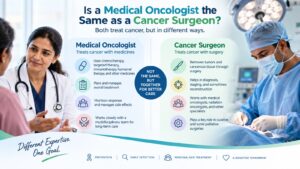
No.
They are different oncology specialties.
Medical Oncologist
Focuses on cancer treatment using medicines such as:
- Chemotherapy
- Immunotherapy
- Targeted therapy
- Hormone therapy
Surgical Oncologist
Focuses on the surgical treatment of cancer.
For example:
A patient with breast cancer may see a Surgical Oncologist for surgery and a Medical Oncologist for systemic treatment.
A patient may also require a Radiation Oncologist.
Therefore, cancer treatment often involves multiple oncology specialists working together.
What Treatments Does Medical Oncology Provide?

- Chemotherapy
Chemotherapy uses medicines to kill cancer cells or prevent them from growing and dividing.
It may be used:
- Before surgery
- After surgery
- With radiation
- For advanced cancer
- To control disease
- To relieve certain symptoms
The exact drugs and treatment schedule depend on the cancer.
The National Cancer Institute explains that chemotherapy may be used alone or in combination with other treatments depending on the cancer and treatment objective. (cancer.gov)
Searches connected to chemotherapy
- Best Chemotherapy Hospital in Hyderabad
- Chemotherapy in Hyderabad
- Chemotherapy Treatment Hyderabad
- Cancer Chemotherapy Specialist Hyderabad
- Cancer Medicine Specialist Hyderabad
- Immunotherapy
Immunotherapy uses treatments that help the immune system recognize and fight cancer.
Some immunotherapies work by helping immune cells attack cancer cells more effectively.
Examples include immune checkpoint inhibitors and other immune-based treatments.
Immunotherapy is not appropriate for every patient.
Its use depends on factors such as:
- Cancer type
- Cancer stage
- Biomarkers
- Previous treatment
- Overall clinical condition
The National Cancer Institute identifies several types of immunotherapy and explains that these treatments are used for selected cancers and patients. (cancer.gov)
Searches connected to immunotherapy
- Immunotherapy in Hyderabad
- Immunotherapy Hospital Hyderabad
- Immunotherapy Cancer Treatment Hyderabad
- Cancer Immunotherapy Specialist Hyderabad
- Best Immunotherapy Doctor Hyderabad
- Targeted Therapy
Targeted therapy is designed to act on specific molecules or proteins that help cancer cells grow, divide or spread.
Some targeted treatments are used only when testing shows that the cancer has the relevant target.
This is why molecular and biomarker testing can be an important part of modern cancer treatment.
Targeted therapy can be used for several cancer types, but the available treatments and targets differ between cancers. (cancer.gov)
Searches connected to targeted therapy
- Targeted Therapy in Hyderabad
- Targeted Cancer Treatment Hyderabad
- Molecular Cancer Treatment Hyderabad
- Precision Oncology Hyderabad
- Cancer Biomarker Testing Hyderabad
- Hormone Therapy
Some cancers depend on hormones to grow.
Hormone therapy works by reducing hormone production or blocking the effects of hormones on cancer cells.
It is particularly important in selected:
- Breast cancers
- Prostate cancers
The specific treatment depends on the biology of the cancer. (cancer.gov)
- Combination Cancer Treatment
Many patients do not receive just one treatment.
A cancer treatment plan may combine:
Surgery + Chemotherapy
Surgery + Radiation
Chemotherapy + Radiation
Surgery + Chemotherapy + Radiation
or combinations involving:
Immunotherapy
or:
Targeted Therapy
The sequence and combination depend on the diagnosis.
This is why Medical Oncology often works closely with Surgical Oncology and Radiation Oncology.
Medical Oncology and Multidisciplinary Cancer Care
Cancer treatment is increasingly multidisciplinary.
A patient’s treatment plan may involve:
Medical Oncologist
Systemic cancer treatment
Surgical Oncologist
Cancer surgery
Radiation Oncologist
Radiation treatment
Pathologist
Cancer diagnosis and characterization
Radiologist
Imaging and disease assessment
Other specialists
Depending on the cancer and patient’s needs.
Basavatarakam’s official Medical Oncology information describes multidisciplinary care involving Medical Oncology, Surgical Oncology, Radiation Oncology, pain management, physiotherapy, social work and psychology. (appointment.basavatarakam.org)
The hospital also states that complex cases can be discussed through a multidisciplinary Tumor Board. (basavatarakam.org)
This can be especially important when treatment involves several modalities.
Medical Oncology for Different Types of Cancer
Medical Oncology is involved in the treatment of many different cancers.
Breast Cancer
Depending on the cancer’s characteristics, Medical Oncology may involve:
- Chemotherapy
- Hormone therapy
- Targeted therapy
- Immunotherapy in selected patients
Treatment may be combined with surgery and radiation.
Lung Cancer
Medical treatment may include:
- Chemotherapy
- Immunotherapy
- Targeted therapy
Molecular testing may be important in selected lung cancers because certain genetic alterations can influence treatment choices.
Colorectal Cancer
Medical Oncology may use:
- Chemotherapy
- Targeted therapy
- Immunotherapy in selected patients
Treatment may be combined with surgery and, in selected cases, radiation.
Stomach Cancer
Depending on the disease, Medical Oncology may involve:
- Chemotherapy
- Targeted therapy
- Immunotherapy in selected situations
Surgery and radiation may also form part of treatment.
Liver Cancer
Treatment depends on the type of liver cancer, stage, liver function and other clinical factors.
Systemic treatment may be appropriate for selected patients.
Pancreatic Cancer
Medical treatment can be an important component of care and may be used before or after surgery or for advanced disease depending on the clinical situation.
Head and Neck Cancer
Medical Oncology may involve:
- Chemotherapy
- Targeted therapy
- Immunotherapy
It may be combined with surgery or radiation.
Prostate Cancer
Hormone-based treatment and other systemic therapies can play an important role in selected prostate cancers.
Brain Tumours
Medical treatment depends strongly on tumour type and molecular characteristics.
Selected brain tumours may require systemic medicines alongside surgery and radiation.
Medical Oncology for Advanced and Metastatic Cancer
Medical Oncology plays an important role when cancer has spread to other parts of the body.
Advanced cancer does not mean that every treatment option has ended.
Depending on the cancer, treatment may aim to:
- Control disease
- Slow progression
- Reduce symptoms
- Improve quality of life
- Extend survival
Treatment options may include:
- Chemotherapy
- Immunotherapy
- Targeted therapy
- Hormone therapy
- Other systemic treatments
The appropriate approach depends on the cancer and the patient’s condition.
What Is Precision Oncology?
Precision Oncology refers to using information about a patient’s cancer to help guide treatment selection.
This may involve:
- Tumour pathology
- Biomarker testing
- Molecular testing
- Genetic alterations
- Other characteristics of the cancer
The purpose is not to give every patient a completely different treatment.
Instead, it helps identify treatments that may be more appropriate for patients whose cancers have particular characteristics.
Targeted therapy is one important example of treatment guided by molecular information. (cancer.gov)
Why Biomarker Testing Can Matter
A patient’s cancer may contain biological characteristics that influence treatment.
For selected cancers, doctors may recommend biomarker testing before choosing certain treatments.
For example, testing may help determine whether a cancer has a molecular target for which a targeted therapy is available.
Biomarker testing is not required for every cancer or every treatment.
The appropriate tests depend on the diagnosis.
How Is a Medical Oncology Treatment Plan Created?
A Medical Oncologist may consider several factors.
Step 1: Confirm the diagnosis
The cancer diagnosis is established using appropriate pathology and diagnostic tests.
Step 2: Determine the stage
Staging helps determine the extent of disease.
Step 3: Review tumour characteristics
The doctor may review:
- Histopathology
- Immunohistochemistry
- Biomarkers
- Molecular findings
when relevant.
Step 4: Review the patient’s health
The doctor considers:
- Age
- General health
- Other medical conditions
- Previous treatment
- Organ function
- Performance status
Step 5: Determine treatment goals
The goal may be:
- Cure
- Reducing recurrence risk
- Disease control
- Slowing progression
- Symptom management
Step 6: Select the treatment
The Medical Oncologist recommends the treatment most appropriate for the diagnosis.
Step 7: Monitor response
The patient is monitored during treatment to evaluate effectiveness and manage side effects.
What Happens During a Medical Oncology Consultation?
During the first consultation, the doctor may review:
- Biopsy reports
- Pathology reports
- Imaging
- Blood tests
- Previous surgery
- Previous chemotherapy
- Radiation treatment
- Other medical history
The doctor may then explain:
- The diagnosis
- Stage
- Treatment options
- Recommended treatment
- Treatment goals
- Possible side effects
- Expected treatment schedule
- Follow-up requirements
Additional tests may be recommended if more information is required.
What Should You Bring to a Medical Oncology Appointment?
If you are visiting a Medical Oncologist for the first time, bring available copies of:
- Biopsy report
- Histopathology report
- Immunohistochemistry report
- CT/MRI/PET-CT reports
- Imaging discs
- Blood-test reports
- Previous surgery reports
- Chemotherapy records
- Radiation treatment records
- Current medication list
- Previous medical records
Complete information helps the doctor understand the patient’s diagnosis and treatment history.
Managing Side Effects During Cancer Treatment
Cancer medicines can cause side effects.
The type and severity depend on:
- Drug or treatment used
- Dose
- Treatment combination
- Individual patient factors
Possible side effects may include:
- Fatigue
- Nausea
- Vomiting
- Changes in appetite
- Hair loss
- Changes in blood counts
- Mouth sores
- Skin changes
- Neuropathy
Not every patient experiences the same side effects.
Medical Oncology teams monitor patients during treatment and provide supportive treatment when needed.
Patients should report new or severe symptoms to their treating team rather than stopping cancer treatment on their own.
Is Chemotherapy the Same for Every Cancer?
No.
There is no universal chemotherapy treatment.
Different cancers respond to different medicines.
The treatment can vary based on:
- Cancer type
- Stage
- Pathology
- Biomarkers
- Previous treatment
- Patient’s overall condition
This is one reason patients should not compare their chemotherapy schedule directly with another person’s treatment.
Is Immunotherapy Better Than Chemotherapy?
Neither treatment is automatically better for every patient.
Immunotherapy can be highly effective in selected cancers, while chemotherapy remains an important treatment for many cancers.
In some situations, they may even be used together.
The appropriate treatment depends on the specific cancer and available evidence.
Can Medical Oncology and Radiation Oncology Be Used Together?
Yes.
For selected cancers, systemic treatment and radiation therapy may be planned together or sequentially.
For example, chemotherapy or other systemic treatment may be used with radiation in certain cancers.
The exact treatment sequence depends on the diagnosis.
This is why coordination between Medical Oncology and Radiation Oncology is important.
Medical Oncology at Basavatarakam
Basavatarakam Indo-American Cancer Hospital & Research Institute in Banjara Hills, Hyderabad, has a dedicated Medical Oncology department.
The hospital’s official Medical Oncology information describes services for adult and pediatric cancers and highlights a multidisciplinary approach involving Medical Oncology, Surgical Oncology, Radiation Oncology and supportive-care specialists. (appointment.basavatarakam.org)
The hospital’s official department directory also lists Medical Oncology among its major oncology services. (appointment.basavatarakam.org)
This multidisciplinary structure allows Medical Oncology to connect with surgical, radiation and supportive-care services according to the patient’s treatment needs.
Why Choose a Dedicated Medical Oncology Team?
When searching for Medical Oncology in Hyderabad, patients should consider more than the availability of chemotherapy.
Important factors include:
- Medical Oncology expertise
- Disease-specific experience
- Multidisciplinary support
- Diagnostic facilities
- Pathology support
- Biomarker and molecular evaluation where appropriate
- Access to Surgical Oncology
- Access to Radiation Oncology
- Supportive-care services
- Follow-up and treatment monitoring
A comprehensive cancer institution can bring many of these services together.
How to Choose a Medical Oncologist in Hyderabad
Patients searching for the best Medical Oncologist in Hyderabad should consider:
Relevant expertise
Does the doctor regularly treat the type of cancer involved?
Qualifications
What are the doctor’s medical and oncology qualifications?
Experience
How long has the doctor been working in oncology, and what areas of cancer care does the doctor focus on?
Treatment approach
Does the doctor explain treatment options and the reasons behind recommendations?
Multidisciplinary support
Can the doctor coordinate with surgeons and Radiation Oncologists when needed?
Communication
Can the patient and family understand the diagnosis and treatment plan?
These factors are more meaningful than relying on the word “best” alone.
Frequently Asked Questions About Medical Oncology
What is Medical Oncology?
Medical Oncology is the branch of oncology focused on treating cancer using medicines such as chemotherapy, immunotherapy, targeted therapy and hormone therapy.
What does a Medical Oncologist do?
A Medical Oncologist diagnoses and manages cancer using systemic treatments and works with other specialists to coordinate multidisciplinary cancer care.
Is a Medical Oncologist a cancer doctor?
Yes. A Medical Oncologist is a specialist cancer doctor who primarily manages cancer using medical treatments.
Is a Medical Oncologist the same as a Surgical Oncologist?
No. Medical Oncologists specialize in cancer medicines, while Surgical Oncologists specialize in cancer surgery.
When should I see a Medical Oncologist?
A Medical Oncologist may be involved after a cancer diagnosis, particularly when chemotherapy, immunotherapy, targeted therapy, hormone therapy or other systemic treatment is being considered.
Is chemotherapy always necessary?
No. Chemotherapy is not required for every cancer patient. Its use depends on the cancer type, stage and treatment plan.
Is immunotherapy suitable for everyone?
No. Immunotherapy is appropriate for selected cancers and patients.
Does targeted therapy require special testing?
For many targeted treatments, testing may be needed to determine whether the cancer has the relevant molecular target.
Can a Medical Oncologist treat advanced cancer?
Yes. Medical Oncology plays an important role in treating many advanced and metastatic cancers, with treatment goals that may include disease control, symptom relief and prolonging survival.
Can children see a Medical Oncologist?
Children with cancer generally require Pediatric Oncology specialists who have specific training and experience in treating childhood cancers.
Where can I find Medical Oncology in Hyderabad?
Basavatarakam Indo-American Cancer Hospital & Research Institute in Banjara Hills provides dedicated Medical Oncology services as part of its comprehensive cancer-care system.
Medical Oncology in Hyderabad: Finding the Right Cancer Care Team
Searching for Medical Oncology in Hyderabad is often only the beginning.
The more important question is whether the oncology team has the expertise required for the patient’s particular cancer.
Modern Medical Oncology goes beyond chemotherapy.
It can involve:
Diagnosis
↓
Cancer Staging
↓
Pathology and Biomarker Assessment
↓
Treatment Planning
↓
Chemotherapy / Immunotherapy / Targeted Therapy / Hormone Therapy
↓
Monitoring
↓
Supportive Care
↓
Follow-Up
And for many patients:
Medical Oncology + Surgical Oncology + Radiation Oncology
working together.
Conclusion
Medical Oncology is a central part of modern cancer treatment.
Medical Oncologists use systemic treatments such as chemotherapy, immunotherapy, targeted therapy and hormone therapy depending on the type, stage and biological characteristics of the cancer.
The appropriate treatment is different for every patient.
For this reason, patients searching for the best Medical Oncologist in Hyderabad should look beyond generic rankings and consider relevant cancer expertise, qualifications, experience, multidisciplinary support and the ability to provide an individualized treatment plan.
Basavatarakam Indo-American Cancer Hospital & Research Institute in Banjara Hills, Hyderabad, provides dedicated Medical Oncology services within a broader multidisciplinary cancer-care system. Its official information describes coordination between Medical Oncology, Surgical Oncology, Radiation Oncology and supportive-care services.
If you or a family member has been diagnosed with cancer, consult a qualified Medical Oncologist to understand the diagnosis and the treatment options appropriate for the individual situation.